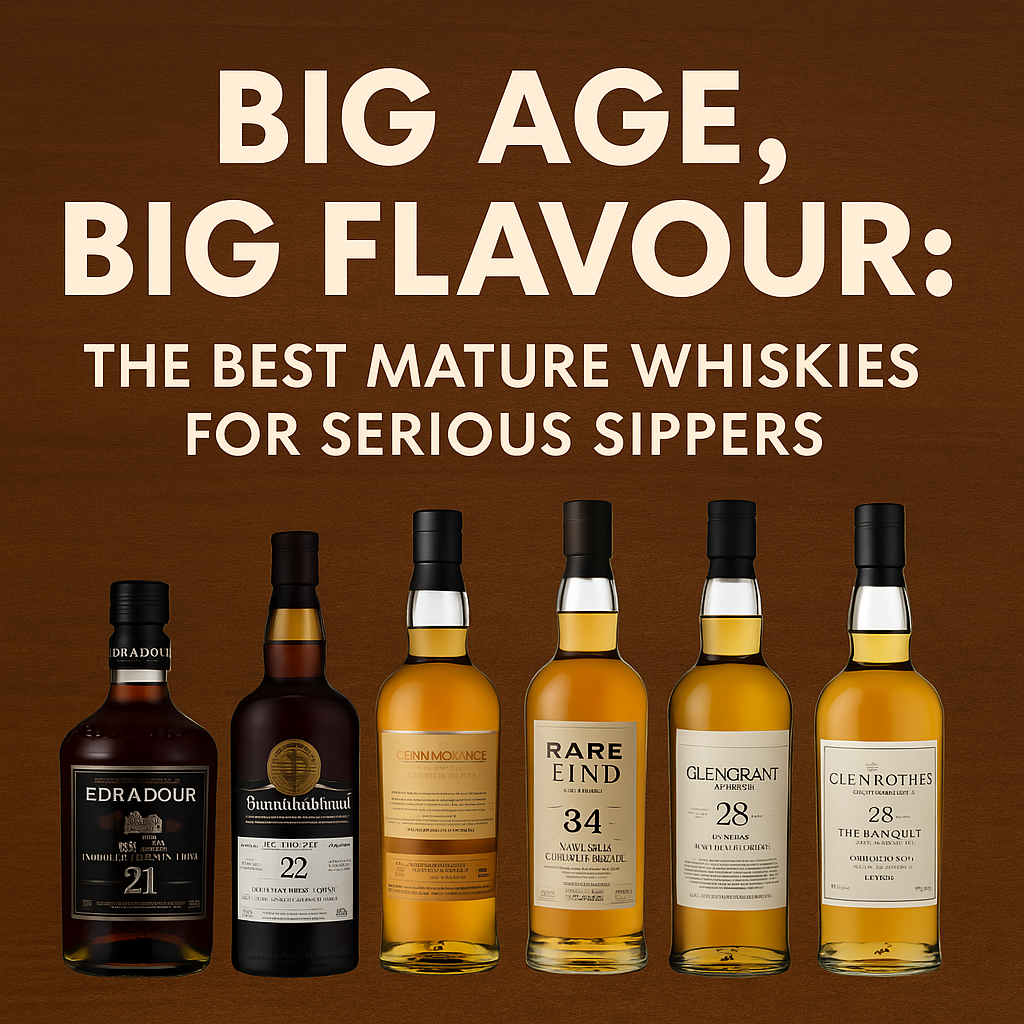
Big Age, Big Flavour: Best Mature Scotch Whiskies for Serious Sippers
What makes the best mature Scotch whiskies so rewarding? Sometimes it’s the richness of decades in oak. Sometimes it’s the combination of fruit, spice and smoke. And occasionally, it’s an unexpected whisky that delivers more character than its age statement might suggest.
Long maturation can create extraordinary depth, but age alone doesn’t guarantee flavour or quality. The type of oak, previous cask contents, distillery character and bottling strength all influence the final whisky.
In this guide, we explore six mature Scotch whiskies for enthusiasts who appreciate distinctive flavour. From sherry-rich Highland single malts to a 34-year-old blend and a coastal Campbeltown expression, these bottles demonstrate just how varied older Scotch can be.
Buying note: These are premium and, in some cases, limited or release-specific whiskies. Check current prices, availability and exact bottling details before purchasing.
Quick Picks: Best Mature Scotch Whiskies
- Best rich Highland malt: GlenDronach 21 Year Old.
- Best mature Islay whisky: Bunnahabhain 25 Year Old.
- Best mature blended Scotch: Gleann Mór Rare Find 1989 34 Year Old.
- Best independent Highland bottling: Tomatin 1993 30 Year Old.
- Best mature sherry-cask Speyside malt: Glenrothes 1992 31 Year Old.
- Best mature Campbeltown whisky: Glen Scotia 25 Year Old 2022 Release.
Best Mature Scotch Whiskies Compared
| Whisky | Age | Region / Style | Flavour Direction |
|---|---|---|---|
| GlenDronach 21 | 21 years | Highland single malt | Dried fruit, spice, rich oak |
| Bunnahabhain 25 | 25 years | Islay single malt | Fruit, nuts, coastal character |
| Gleann Mór Rare Find 1989 | 34 years | Blended Scotch | Mature oak, fruit, spice |
| Tomatin 1993 Cask #6812 | 30 years | Highland single malt | Fruit, malt, developed oak |
| Glenrothes 1992 Cask #6048 | 31 years | Speyside single malt | Sherry fruit, nuts, spice |
| Glen Scotia 25 2022 Release | 25 years | Campbeltown single malt | Fruit, oak, coastal notes |
1. GlenDronach 21 Year Old – Best Rich Highland Single Malt
GlenDronach 21 Year Old is a natural choice for enthusiasts who appreciate the combination of mature whisky and pronounced sherry-cask influence.
GlenDronach is known for its rich Highland character and long association with sherry maturation. Its older expressions can display a combination of dried fruit, spice, chocolate and developed oak.
At 21 years old, this is a whisky for drinkers who enjoy layered flavours rather than simply chasing maximum intensity.
Why It’s Worth Considering
- 21-year age statement.
- Strong sherry-cask identity.
- Rich Highland single malt character.
- Interesting option for experienced sherried-whisky drinkers.
Typical flavour direction: Raisins, dark fruit, chocolate, spice and oak.
Best for: Fans of mature, rich, unpeated Scotch.
Explore GlenDronach 21 Year Old →
2. Bunnahabhain 25 Year Old – Best Mature Islay Single Malt
Bunnahabhain 25 Year Old demonstrates that mature Islay whisky doesn’t have to be dominated by peat smoke.
Unlike many famous Islay malts, Bunnahabhain’s core unpeated style places greater emphasis on malt, fruit, oak and coastal character.
Its 25-year-old expression is a compelling choice for someone who enjoys the complexity of older whisky without necessarily wanting heavy smoke.
Why It’s Worth Considering
- 25-year age statement.
- Unpeated Bunnahabhain character.
- Mature fruit and oak influence.
- Distinctive alternative to smoky Islay malts.
Typical flavour direction: Dried fruit, nuts, spice, oak and gentle coastal notes.
Best for: Drinkers who enjoy mature whisky with depth rather than intense peat.
Explore Bunnahabhain 25 Year Old →
3. Gleann Mór Rare Find 1989 34 Year Old – Best Mature Blended Scotch
Gleann Mór Rare Find 1989 34 Year Old challenges the assumption that serious mature whisky must be single malt.
Blended Scotch can contain whiskies with extensive maturation histories, and an age statement of 34 years means that the youngest component has spent at least 34 years in oak.
This independent bottling provides an opportunity to explore how long maturation influences a blended Scotch whisky.
Why It’s Worth Considering
- 34-year age statement.
- 1989 vintage designation.
- Independent bottling by Gleann Mór.
- Unusual opportunity to compare mature blended Scotch with single malt.
Typical flavour direction: Mature fruit, oak, malt sweetness and spice; check the exact bottling’s tasting notes for greater precision.
Best for: Experienced drinkers interested in older blends.
Explore Gleann Mór Rare Find 34 Year Old →
4. Tomatin 1993 30 Year Old Cask #6812 – Best Mature Independent Highland Malt
Tomatin 1993 30 Year Old Cask #6812 is an interesting choice for drinkers who enjoy exploring mature whisky through independent bottlings.
Released under Gordon & MacPhail’s Connoisseurs Choice series, this expression has a clearly identified vintage, age statement and cask number.
Tomatin’s spirit is often associated with fruit and malt character, which can develop additional complexity during extended oak maturation.
Why It’s Worth Considering
- 1993 distillation vintage.
- 30-year age statement.
- Identified cask number: 6812.
- Gordon & MacPhail independent bottling.
Typical flavour direction: Mature orchard fruit, malt, oak and spice, subject to the exact cask profile.
Best for: Enthusiasts who appreciate vintage and single-cask details.
Explore Tomatin 1993 30 Year Old →
5. Glenrothes 1992 31 Year Old – Best Mature Sherry-Cask Speyside Whisky
Glenrothes 1992 31 Year Old Cask #6048 offers a fascinating combination of long maturation and Oloroso sherry-cask influence.
The listing identifies a 1992 vintage, 31 years of maturation and an individual Oloroso sherry cask.
For drinkers who enjoy rich, mature Speyside whisky, it provides an opportunity to investigate how decades in oak can shape dried-fruit, spice and nutty flavours.
Why It’s Worth Considering
- 1992 vintage.
- 31-year age statement.
- Oloroso sherry cask.
- Identified cask number: 6048.
Typical flavour direction: Dried fruit, nuts, oak and spice; exact tasting notes should be checked against the individual bottling.
Best for: Sherry-cask enthusiasts interested in mature single-cask whisky.
Explore Glenrothes 1992 31 Year Old →
6. Glen Scotia 25 Year Old 2022 Release – Best Mature Campbeltown Whisky
Glen Scotia 25 Year Old 2022 Release brings Campbeltown character into this mature-whisky selection.
Glen Scotia is known for expressions that can combine fruit, oak, spice and maritime notes.
At 25 years old, this release offers an opportunity to explore how extended maturation can influence the distillery’s character.
Why It’s Worth Considering
- 25-year age statement.
- Identified 2022 release.
- Campbeltown single malt.
- Distinctive regional character.
Typical flavour direction: Fruit, oak, gentle spice and coastal notes.
Best for: Experienced drinkers who enjoy mature Campbeltown whisky.
Explore Glen Scotia 25 Year Old →
What Makes Mature Scotch Whisky Taste Different?
During maturation, Scotch whisky interacts with the oak cask. Over time, this can influence colour, aroma, texture and flavour.
Long maturation may bring greater oak complexity, developed fruit, spice and a rounded character.
However, these changes depend on several factors:
- Cask type: Bourbon, sherry and other casks contribute different flavour characteristics.
- Oak activity: First-fill and refill casks can behave differently.
- Distillery spirit: A fruity Speyside malt develops differently from a peated Islay whisky.
- Warehouse conditions: Temperature and humidity influence maturation.
- Bottling strength: Alcohol strength affects the tasting experience.
Longer maturation doesn’t automatically create better whisky. An active cask can sometimes overwhelm a spirit, while a well-managed refill cask may preserve more distillery character.
Does Older Scotch Whisky Have More Flavour?
Not necessarily.
Older whisky may offer more developed oak and maturation character, but younger expressions can be equally intense or complex.
A heavily peated 10-year-old whisky may taste more immediately powerful than a delicate 30-year-old Speyside malt.
It’s helpful to distinguish between flavour intensity and flavour complexity.
Intensity describes how strongly flavours register. Complexity describes how many distinct or evolving characteristics you notice.
A mature whisky may be subtle, intense, complex or a combination of all three.
How Cask Type Changes Mature Whisky
Sherry Casks
Sherry-associated oak can contribute dried fruit, nuts, spice, chocolate and rich oak notes.
GlenDronach 21 and the Oloroso-cask Glenrothes in this guide are useful examples of sherry influence.
Bourbon Casks
Ex-bourbon oak often contributes vanilla, honey, coconut, caramel and spice.
Over longer maturation periods, these characteristics may develop alongside more pronounced oak notes.
Refill Casks
Refill casks have previously held Scotch whisky and may contribute oak influence more gradually.
They can be especially interesting for long maturation because they may allow more of the original spirit character to remain evident.
Multiple-Cask Maturation
Some mature whiskies combine components from different cask types to create a particular balance.
This can add complexity, but the result depends on the individual whisky rather than the number of casks used.
Does Cask Strength Make Mature Whisky Better?
Cask-strength whisky is bottled without the usual reduction to a standard drinking strength, although exact production and bottling practices vary.
It can offer a concentrated tasting experience and give drinkers more control over dilution.
However, higher ABV doesn’t automatically mean better flavour.
A mature whisky bottled at 43% or 46% can be exceptionally rewarding, while a cask-strength expression may require a little water to reveal its full character.
Judge the balance and quality of the whisky, not simply the number on the label.
How to Taste Mature Scotch Whisky
- Use a suitable glass: A tulip-shaped whisky glass can help concentrate aromas.
- Start with a small pour: There’s no need to rush.
- Explore the aroma: Look for fruit, spice, oak, smoke or coastal notes.
- Take a small sip: Notice how flavours develop.
- Consider adding water: A little dilution can change the tasting experience.
- Pay attention to the finish: Notice which flavours remain after swallowing.
- Compare different styles: A mature sherried Highland malt and a mature Campbeltown whisky may offer very different experiences.
How to Choose a Mature Scotch Whisky
Before buying an expensive aged whisky, think about the style you actually enjoy.
| If You Prefer | Consider |
|---|---|
| Rich dried fruit and sherry spice | GlenDronach 21 |
| Unpeated Islay character | Bunnahabhain 25 |
| Very mature blended Scotch | Gleann Mór Rare Find 34 |
| Vintage Highland single malt | Tomatin 1993 30 |
| Long-aged Oloroso sherry-cask whisky | Glenrothes 1992 31 |
| Campbeltown fruit and coastal character | Glen Scotia 25 |
Are Mature Scotch Whiskies Worth the Money?
That depends on your budget and what you want from the bottle.
Long-aged Scotch can be expensive because maturation involves time, storage, evaporation losses and limited remaining stock.
But a high price doesn’t guarantee that you’ll enjoy it more than a younger whisky.
Before buying, compare the distillery style, maturation details, bottling strength and current price.
If possible, try a sample or a dram before committing to a particularly expensive bottle.
Common Mistakes When Buying Mature Whisky
- Buying purely by age: Older doesn’t automatically mean better.
- Assuming cask strength is superior: Balance matters more than ABV alone.
- Ignoring the cask: Maturation type can be as important as age.
- Confusing rarity with drinking quality: Scarcity doesn’t guarantee flavour.
- Overlooking bottle condition: This matters especially for historic or expensive releases.
- Assuming all Islay whisky is smoky: Bunnahabhain’s core unpeated style is an important exception.
- Ignoring independent bottlers: They can offer distinctive mature whiskies.
- Buying without checking the exact edition: Vintage, cask number and release year may identify different bottles.
Frequently Asked Questions About Mature Scotch Whisky
What is considered mature Scotch whisky?
There is no single legal age at which Scotch becomes “mature” in the premium sense. All Scotch must meet its minimum legal maturation period, but enthusiasts often use the term for older expressions such as 18, 21, 25 or 30-year-old whiskies.
Is 25-year-old Scotch better than 12-year-old Scotch?
Not necessarily. They may offer different maturation characteristics, but quality and enjoyment depend on the individual whisky.
Does Scotch whisky improve with age?
Age changes whisky during cask maturation, but those changes are not always improvements. The cask and spirit must remain in balance.
Does whisky continue ageing in the bottle?
No. The age statement refers to time spent maturing in oak before bottling.
What does cask strength mean?
It generally refers to whisky bottled at or close to its natural cask strength rather than reduced to a standard bottling strength.
Is mature whisky smoother?
Some older whiskies develop a rounded texture, but smoothness is subjective and not determined by age alone.
What is the best mature sherry-cask Scotch?
GlenDronach 21 and mature sherry-cask Glenrothes bottlings are worth comparing if you enjoy dried fruit and spice.
Can blended Scotch be aged for 30 years?
Yes. The age statement refers to the youngest whisky in the blend.
Is Bunnahabhain 25 smoky?
Bunnahabhain’s core 25-year-old expression belongs to the distillery’s predominantly unpeated style rather than the heavily peated profile associated with some other Islay malts.
What is an independent whisky bottling?
It is whisky released by a company other than the producing distillery, often with specific vintage or cask information.
Should I add water to mature whisky?
You can. A few drops may change the aroma and flavour, especially with higher-strength expressions.
Is older whisky more collectible?
Sometimes, but collectability depends on rarity, demand, condition and the exact release as well as age.
How should expensive Scotch be stored?
Store bottles upright, away from direct sunlight and significant temperature fluctuations.
Are mature whiskies a good investment?
Some bottles attract collector interest, but prices can rise or fall. Whisky should not be treated as a guaranteed investment.
Explore More Whisky Guides on ModHaven
- Sherried Whisky – Explore rich cask-matured Scotch.
- Cask Strength Whisky – Learn about higher-strength expressions.
- Browse Scotch Whisky – Compare additional expressions and current retailer listings.
Final Verdict: Best Mature Scotch Whiskies for Serious Sippers
The best mature Scotch whiskies aren’t necessarily the oldest or most expensive bottles. They’re the expressions where distillery character, cask influence and time in oak come together in a way you enjoy.
For rich Highland whisky, GlenDronach 21 is a compelling choice. For mature unpeated Islay character, consider Bunnahabhain 25.
Gleann Mór Rare Find 34 shows what mature blended Scotch can offer, while Tomatin 1993 and Glenrothes 1992 highlight the appeal of vintage independent bottlings.
For something with Campbeltown identity, Glen Scotia 25 completes the selection.
Choose the style you love, investigate the exact bottling and let flavour—not age alone—guide your purchase.
Affiliate disclosure: ModHaven may earn a commission from qualifying purchases through retailer links, at no additional cost to you. Prices, stock and specifications may change. Alcohol is intended for adults of legal drinking age. Please drink responsibly.